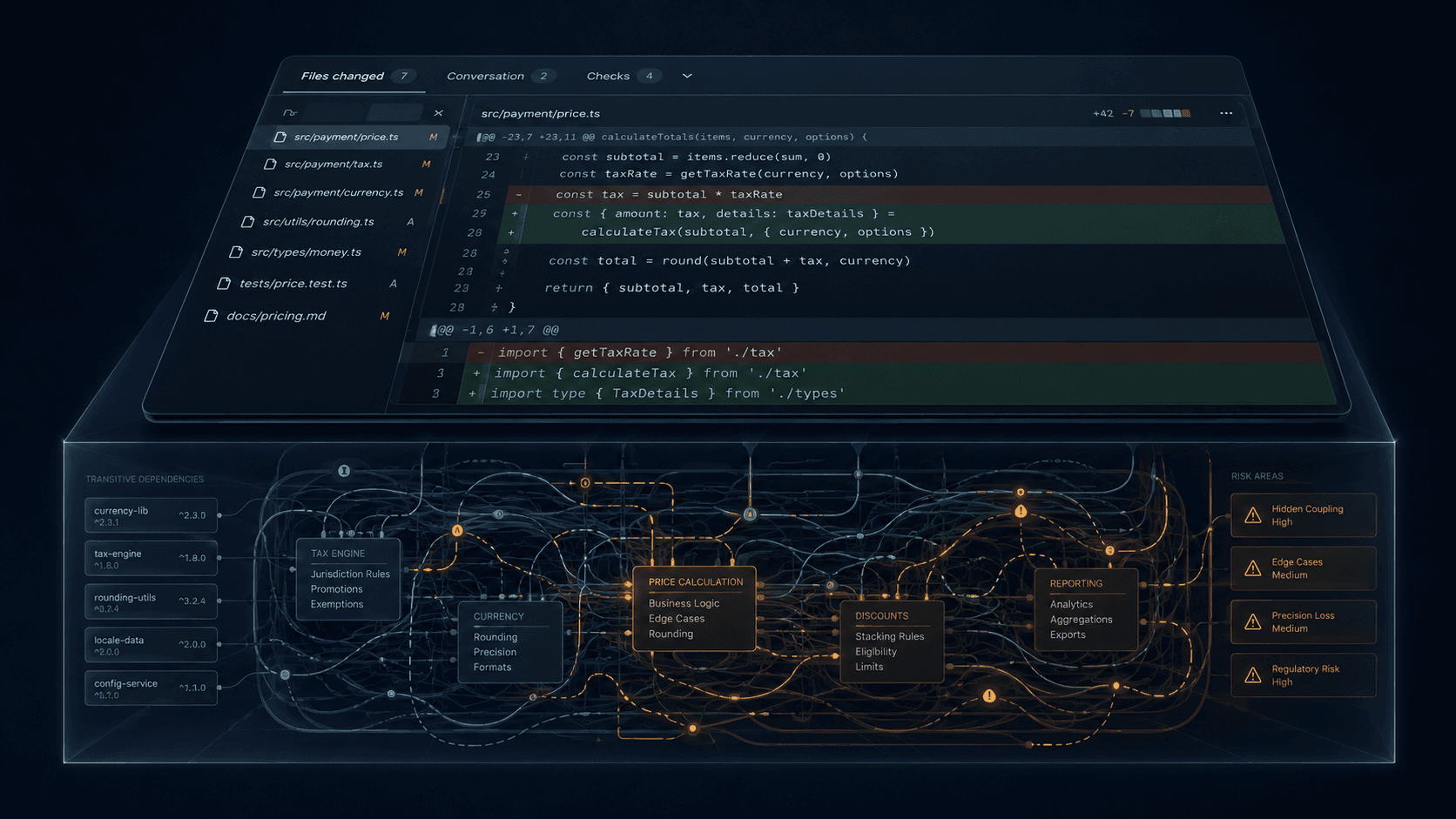
AI-generated pull requests are becoming normal much faster than teams are adapting their review habits
That mismatch is the real problem.
The issue is not that AI can open a pull request. Of course it can. The issue is that many teams are still reviewing AI-generated PRs with the same instincts they use for human-authored work, even though the risk profile is different.
A human developer usually leaves a trail of intent. You can often infer what they understood, what tradeoffs they made, and where they were uncertain. An AI-generated PR can look superficially competent while hiding a very different kind of weakness: shallow local correctness, weak architectural judgment, unnecessary code expansion, and maintenance costs that land later.
That is why “looks good to me” gets more dangerous once agent-generated PRs become common.
The problem is not that AI writes code
The problem is that AI often writes code that passes the first impression test.
It compiles. It follows naming conventions. It adds tests. It sounds confident. The diff is tidy enough. The pull request description may even look better than the code it is trying to justify.
That surface-level polish is exactly what makes bad review discipline more expensive.
A weak human PR often announces itself. An AI PR frequently does not. It can be articulate and still be wrong. It can be useful and still be overbuilt. It can solve the ticket while quietly making the system harder to reason about.
That changes what review needs to do.
AI PRs fail differently from human PRs
The most important shift is not volume. It is failure mode.
Human-authored code usually reflects the limits of one person’s understanding. AI-generated code often reflects the limits of local pattern matching across a broader space. That means the result may be syntactically solid and contextually weak at the same time.
A few common patterns show up repeatedly.
1. The code solves the prompt, not the system problem
An agent is often very good at satisfying the explicit task in front of it. If the prompt says “add retry logic,” it adds retry logic. If the prompt says “support a new field,” it supports the field. If the prompt says “fix the failing test,” it fixes the test.
What it may not do reliably is ask whether the requested change belongs at that layer, whether the existing abstraction is already wrong, or whether the real issue sits somewhere upstream.
That is how teams end up merging code that is locally correct and globally misguided.
2. The diff gets larger than the problem
AI-generated PRs often expand to fill available context.
A small request becomes:
- a helper abstraction nobody asked for
- a refactor adjacent to the change
- extra types that add indirection without adding clarity
- defensive branches for cases that do not exist
- tests that validate the implementation shape more than the business behavior
This is one of the easiest ways maintenance debt sneaks in. The PR looks productive because it contains a lot of work. In reality, it may just contain a lot of code.
3. The code sounds more intentional than it is
A confident PR description is not evidence of good judgment.
This matters because AI tooling is very good at producing review-shaped language: summaries, checklists, risk notes, migration comments, and tidy rationales. That can create the illusion that the implementation has been reasoned through more deeply than it actually has.
Many teams are still too easy to impress with fluent explanation.
4. Tests can reinforce the wrong design
People often assume that test coverage makes AI-generated code safer.
Sometimes it does. Sometimes it just makes the mistake harder to notice.
An agent can write tests that validate the exact structure it just invented. Those tests may pass while still locking in unnecessary abstractions, accidental edge-case behavior, or the wrong boundary for the fix.
Coverage is not the same thing as confidence.
Reviewing AI PRs like normal PRs is a category error
This is the point I think many teams are still missing.
The goal of review is not simply to check whether the code works. It is to inspect whether the change deserves to exist in its current form.
That distinction becomes much more important with AI-generated code, because the main risk is often not obvious breakage. It is silent quality erosion.
If your review habit is mostly:
- skim the summary
- scan the diff
- confirm tests pass
- merge if nothing looks alarming
then you do not really have an AI PR review process. You have a throughput process.
Those are not the same thing.
What reviewers should actually inspect
If agent-generated PRs are becoming common in your workflow, review needs to become more deliberate in a few specific areas.
1. Check whether the change belongs at this layer
Before inspecting syntax or style, ask a more important question:
is this the right place in the system to solve this problem?
This catches a surprising amount of bad AI work.
Agents often optimize for the nearest editable surface. They patch the controller, extend the serializer, add a conditional in the component, or widen a service interface because it is the fastest path to a plausible answer.
That does not mean the system should evolve there.
2. Look for code volume that exceeds problem complexity
If the ticket is small and the PR is sprawling, be suspicious.
Not because bigger diffs are always wrong, but because AI frequently adds implementation bulk that feels reasonable line by line and unnecessary as a whole.
Ask:
- what would the smallest credible solution look like?
- what in this diff is essential?
- what was introduced only because the agent had enough room to keep going?
This is where human taste matters. Good reviewers know when a change is carrying too much ceremony for the value it provides.
3. Review abstractions much harder than the raw fix
AI is often decent at stitching together a direct fix. It is much less trustworthy when inventing abstractions.
That is why new helpers, wrappers, shared utilities, generic hooks, base classes, intermediate types, or “reusable” service layers deserve extra scrutiny.
These are exactly the places where mediocre AI code turns into long-term drag.
A useful rule of thumb is simple:
if the PR introduces a new abstraction, the burden of proof should go up, not down.
4. Read tests for intent, not just coverage
Do the tests prove the behavior you want, or do they merely confirm the code behaves the way the generator happened to implement it?
Look for:
- tests coupled too tightly to implementation details
- redundant cases that add noise without improving confidence
- missing business-level assertions
- snapshots or broad mocks that make shallow correctness look complete
Bad tests are especially dangerous here because they provide false reassurance to a review process that is already moving too quickly.
5. Trace maintenance cost, not just merge risk
Many AI-generated PRs are mergeable and still not worth merging.
That sounds harsh, but it matters.
A change can be functionally acceptable while still making the system noisier, harder to onboard into, more abstract, less coherent, and more expensive to modify later. If review only asks “will this break production today?” then a lot of bad code will get through.
A better question is:
if this pattern spreads, do we want more of it in the codebase?
That is a much more useful standard.
Teams need stricter review triggers for agent-generated work
I do not think every AI PR needs a giant governance ritual. That would be its own form of nonsense.
But teams do need clearer escalation triggers.
A pull request should get deeper review when it:
- introduces a new abstraction
- touches system boundaries or shared libraries
- modifies auth, permissions, payments, or data integrity rules
- changes failure handling or retry logic
- expands significantly beyond the original task
- includes “cleanup” or refactor work mixed into a feature fix
- adds a lot of tests that seem to justify a design more than validate behavior
These are not AI-only concerns, obviously. But AI makes them more frequent and easier to miss.
The review culture needs to change too
This is not only a tooling problem. It is a culture problem.
A lot of teams still reward visible output more than disciplined restraint. If a developer ships three AI-assisted PRs in a day, that can look like velocity. Sometimes it is. Sometimes it is just accelerated entropy.
If the team culture treats review as an approval queue, AI will make that weakness worse.
Healthy review culture for agent-generated work probably looks more like this:
- smaller PRs
- clearer scope boundaries
- less admiration for clever diffs
- more willingness to reject unnecessary abstractions
- more focus on codebase coherence than on short-term throughput
In other words, the team has to care about what the codebase becomes after the merge, not just whether the agent completed the assignment.
Human judgment is not disappearing. It is moving up a level.
This is the part people sometimes frame badly.
The value of human reviewers is not that they can spot every syntax issue better than a model. That is not the interesting comparison.
The value is that a good reviewer can ask higher-level questions the generator is less reliable at answering:
- should this change exist?
- is the design proportionate?
- is this the right boundary?
- is the abstraction justified?
- will this make future work easier or harder?
That is not busywork. That is the job.
As AI-generated PRs become more common, the human role does not disappear. It becomes more architectural, more editorial, and more selective.
That is a good thing, assuming teams are willing to do it properly.
Final thought
AI-generated pull requests are not inherently low quality. Some are useful. Some are excellent. Many are perfectly mergeable.
But they should not be reviewed as if fluent code and passing tests are enough.
The real risk is not that the code looks broken. It is that it looks finished.
That is why teams need a better review standard now, before agent-generated diffs become just another background stream of plausible code entering the system.
If AI is going to accelerate implementation, review has to become more opinionated about architecture, clarity, and maintenance cost.
Otherwise the tool that promised speed will mostly deliver cleanup.