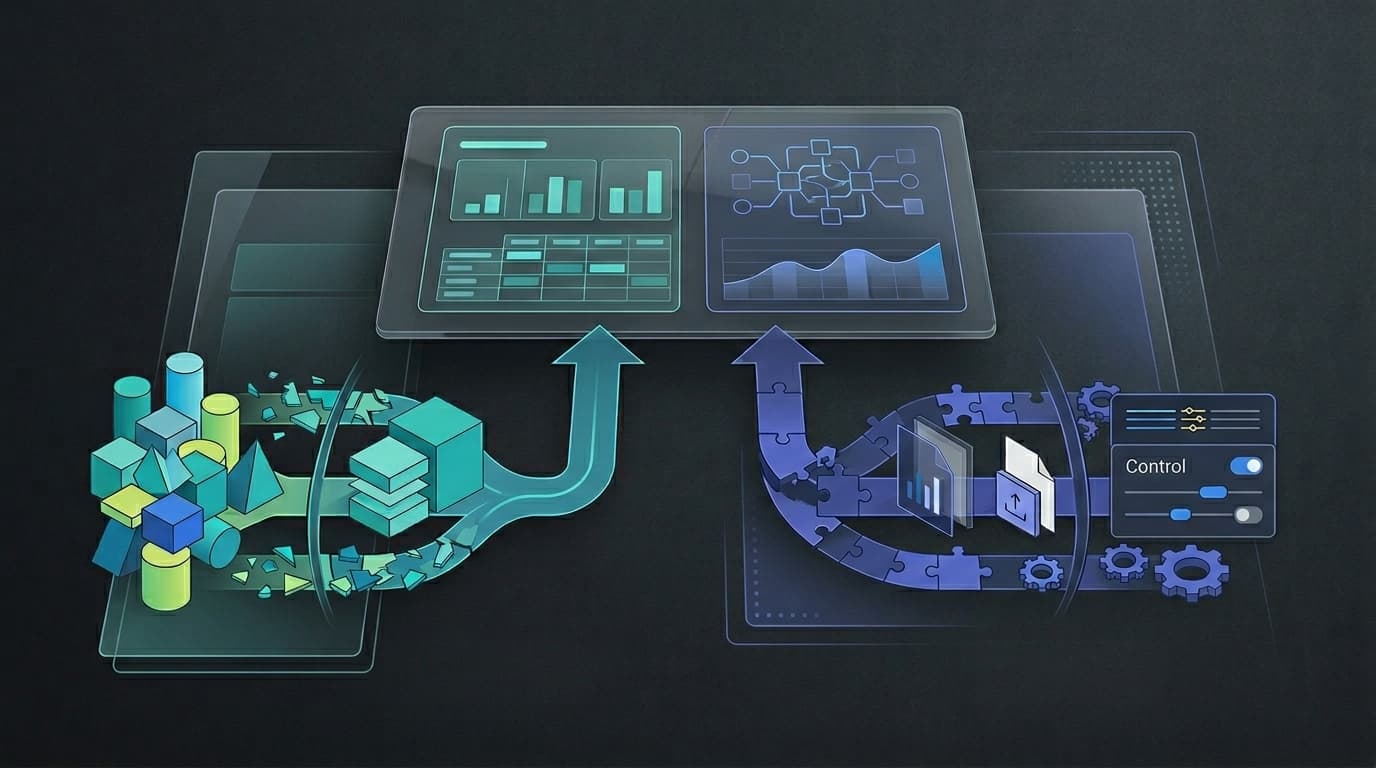
Internal finance tooling usually starts breaking down when one system tries to do too much. What should be a clean boundary between operational expense management, reporting, and manual exception handling turns into duplicated workflows, unclear ownership, and admin panels trying to replace specialized platforms. That was the real issue behind this outgoing payments redesign. The solution was not to keep extending the existing workflow, but to redesign the boundary itself. Instead of forcing the internal admin system to behave like a full expense-management platform, I separated responsibilities more deliberately: externally managed expenses were synced into the system as read-only records, while manual payments remained internal for cases that genuinely required direct control. That made it possible to unify reporting without pretending every payment belonged to the same operational flow.
The Real Problem
The real problem was not the admin friction itself, but the lack of a clear architectural boundary behind it. The system was mixing external operational data, manual exception handling, and internal reporting concerns into the same workflow, without a strong ownership model. Once those responsibilities collapsed into one place, duplication, inconsistency, and maintenance pain became inevitable.
Design Principles
A few design principles shaped the redesign. Operational ownership should remain with the systems that already manage expenses end to end, rather than being partially reimplemented inside an internal admin. A unified reporting surface does not require a single operational model, so synced and manual payments can coexist without pretending they follow the same lifecycle. Where the source of truth is external, synced records should remain read-only. Manual flows should exist, but only as controlled exceptions. Above all, the system should favor clear boundaries and maintainability over flexibility that creates ambiguity later.
The Architecture
The architecture was built around a simple separation: externally managed expenses would be synchronized into the admin as read-only records, while manual payments would remain fully internal. Both sources would appear under the same reporting surface, but each would keep its own ownership and lifecycle rules. That made it possible to unify visibility and reporting without forcing operationally different payments into the same model.
Instead of treating the admin panel as the center of every outgoing payment workflow, the redesign positioned it as a controlled internal layer for visibility, manual exceptions, exports, and receipt access. The external platform continued to own the operational expense flow end to end, while the internal system focused on projection, consistency, and reporting. That boundary reduced complexity without reducing usefulness.
That architectural split only worked because a few technical decisions reinforced it consistently across the system. The goal was not just to separate responsibilities on paper, but to make that separation visible in the data model, API behavior, file handling, and admin workflows. Those decisions are what turned the redesign into something maintainable rather than just conceptually cleaner.
Key Technical Decisions
A few technical decisions were especially important in making the redesign hold up in practice. Each one reinforced the ownership model and helped prevent the internal admin from drifting back toward responsibilities it was never meant to own.
Read-only sync for externally managed expenses
Externally managed expenses were synchronized into the internal system as read-only records. That avoided the complexity of bi-directional sync, removed ownership ambiguity, and kept the admin focused on projection rather than control. In this case, read-only sync was not a missing capability. It was part of the design.
A unified reporting surface without a unified lifecycle
Synced and manual payments appeared under the same administrative surface, but they were not forced into the same operational model. Reporting needed to be unified; lifecycle rules did not. Keeping that distinction explicit made the system easier to reason about and less likely to accumulate hidden inconsistencies over time.
Manual flows as controlled exceptions
Manual payments remained part of the system, but only for cases that genuinely required internal control. They were treated as explicit exceptions rather than as an alternative path competing with the external expense workflow. That reduced duplication without pretending that every payment could or should be automated through a single channel.
Source-aware receipt handling
Receipt access followed the same ownership logic as the payment records themselves. Internally managed receipts could be stored and served directly, while externally managed receipts were handled through a controlled retrieval path instead of being blindly absorbed into the main synchronization process. That kept file handling aligned with the architecture instead of letting it become another quiet source of boundary erosion.
Consistency over fake flexibility
The redesign favored consistency in filtering, exporting, and admin behavior over flexibility that looked powerful but weakened trust in the system. Shared visibility did not mean shared mutation rules, and a unified interface did not require flattening source-specific behavior. That tradeoff made the system simpler, more predictable, and easier to maintain.
Implementation Details
The redesign only worked because the boundary was enforced consistently in implementation, not just described at a higher level. The backend had to project different payment sources into a usable internal model, the frontend had to expose source-aware behavior without creating confusion, and supporting workflows like receipts and imports had to reinforce the same ownership rules instead of quietly bypassing them.
Backend
On the backend, the real challenge was not syncing records, but defining an internal model that could support filtering, reporting, and exports across multiple payment sources without pretending they were operationally identical. Synced and manual payments needed enough shared structure to coexist under the same reporting surface, while still preserving source-specific rules around mutation, lifecycle, and receipt handling.
That boundary also had to be enforced at the API level. Externally managed records could be listed, filtered, and inspected, but not mutated from the admin side. Manual payments remained fully internal and supported the flows that genuinely required direct control. That distinction could not live only in the UI; the backend had to make it true by design.
Frontend
On the frontend, the goal was to unify visibility without flattening behavior. Synced and manual payments appeared in the same administrative surface, but the actions available for each record reflected its source ownership. The interface needed to support a coherent reporting view while still making it obvious which records were read-only, which could be edited, and how actions like receipt access or export should behave.
That mattered because internal finance tooling lives or dies on trust. A page like this is not just a data table; it is an operational surface. If the UI suggests that all records behave the same while the system applies different rules underneath, the workflow becomes harder to understand and easier to misuse.
Receipts and imports
Receipts and imports followed the same architectural logic. Receipt handling could not be treated as a generic file upload problem because file ownership depended on the source of the payment itself. Internally managed records could rely on direct internal storage, while externally managed receipts needed a controlled retrieval path that respected the upstream source instead of folding every binary asset into the main synchronization flow.
Imports needed the same level of control. Manual payments still mattered, but they were treated as explicit exceptions rather than as a competing operational path. That meant CSV ingestion had to be structured, validated, and observable enough to stay useful without becoming another quiet source of inconsistency.
Why This Design Is Maintainable
What made this redesign maintainable was clearer boundaries, not false flexibility. External systems kept ownership of the workflows they were already built to manage, while the internal admin focused on projection, reporting, manual exceptions, and controlled access to supporting data. That reduced duplication without reducing visibility, which is a far better tradeoff than adding more internal logic to create the illusion of completeness.
It also made the system easier to reason about over time. A unified reporting surface did not require a unified operational model, and once that distinction was enforced consistently, the behavior of the system became more predictable. Read-only sync, source-aware actions, structured imports, and controlled manual flows all reinforced the same architectural boundary. The result was a system that was easier to trust, easier to extend, and less likely to drift back into the same design mistakes.
Lessons Learned
- Clear ownership is more valuable than clever integration.
- A unified reporting surface does not require a unified lifecycle.
- Read-only sync can be a design strength when the source of truth lives elsewhere.
- Manual workflows are not the problem; undisciplined manual workflows are.
- Internal tools get fragile when they start absorbing responsibilities that belong elsewhere.
- Maintainability usually comes from clearer architecture, not from adding flexibility everywhere.
Closing Thought
The hardest part of a redesign like this is not the code itself. It is deciding what the system should own, what it should stop pretending to own, and what it should expose. In this case, the outgoing payments workflow improved because the boundary became clearer, not because the system became more powerful. Once ownership was made explicit, the architecture got simpler, the admin experience became more trustworthy, and the system stopped absorbing responsibilities it was never meant to carry.